

Hyperbaric Chambers Australia / Insights
Seated vs Lying Hyperbaric Chamber: Which Suits You?
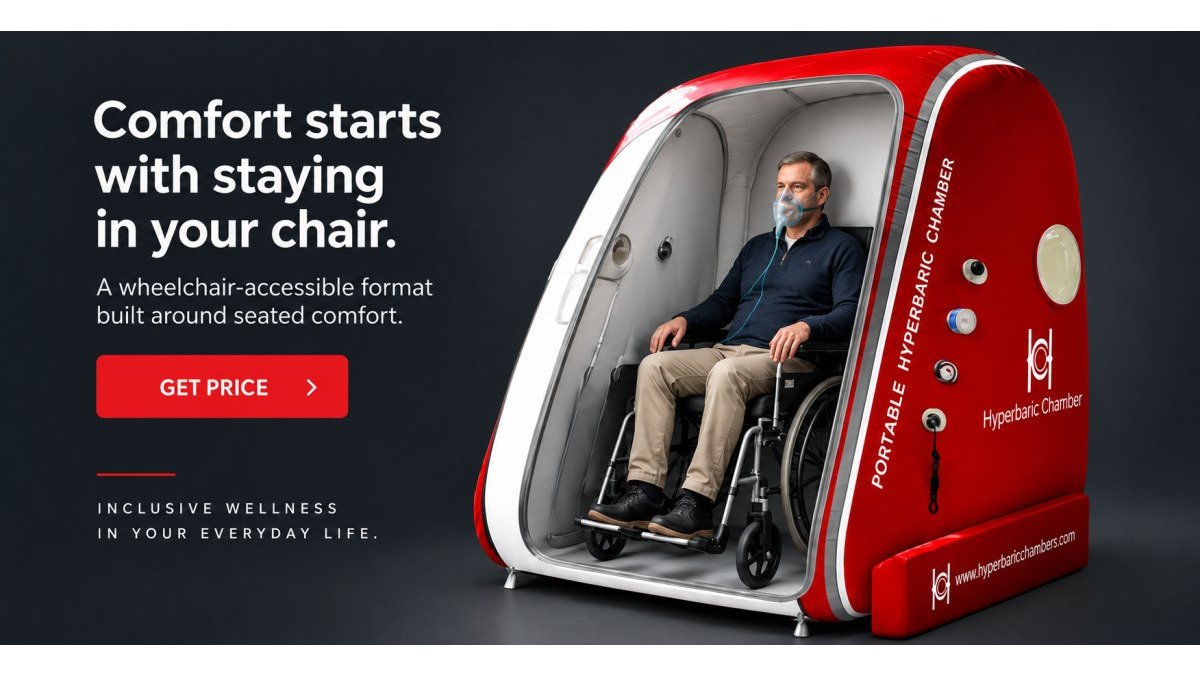
Table of Contents
- Seated vs Lying Hyperbaric Chamber: What Actually Changes
- Side-by-Side Comparison: Seated and Lying Models
- Home Hyperbaric Chamber Dimensions: Cabin Size vs Installed Space
- Hyperbaric Chamber Entry and Exit: What to Test Before You Buy
- Choosing a Hyperbaric Chamber for Limited Mobility
- Realistic Buyer Scenarios: Matching Posture to Daily Life
- Five Questions to Ask Before Choosing a Chamber
- Conclusion
- Frequently Asked Questions
Last Updated: October 5, 2026
Seated vs Lying Hyperbaric Chamber: What Actually Changes
Choosing between a seated and lying [hyperbaric chamber](/best-hyperbaric-chamber-for-home-use-2026/) comes down to three separate decisions: your posture during a session, the shell construction, and the operating pressure. This guide separates them.
The seated vs lying hyperbaric chamber question is really a question about daily use. A chamber you find awkward to enter will sit unused, regardless of how it performs on paper. Posture affects comfort, but it does not determine how well a chamber performs. Pressure, oxygen delivery and session consistency do that work.
Below, we walk through entry and exit, usable interior space, room footprint, mobility needs and realistic buyer scenarios, so you can shortlist with confidence.
Posture, shell type and operating pressure are three independent choices. Settle each one separately before comparing models.
Side-by-Side Comparison: Seated and Lying Models
The table below compares position, shell type, pressure, entry style, external dimensions, usable interior space, equipment space and warranty across our seated and lying range. Confirm current figures on each Australian product page, because specifications differ between models.
| Model | Position | Shell | Pressure | Entry | External footprint | Usable interior | Equipment space | Warranty |
|---|---|---|---|---|---|---|---|---|
| Eclipse 1.5 ATA Seated | Upright seat | Soft-shell | 1.5 ATA | Front zip, seated | Confirm on product page | Seated headroom | Compact | Confirm on product page |
| Eclipse Elite 2.0 ATA Seated | Upright seat | Hard-shell | 2.0 ATA | Door, seated | Confirm on product page | Seated headroom | Larger | Confirm on product page |
| Eclipse Elite 1.35 ATA | Lying | Soft-shell | 1.35 ATA | Full-length zip | Confirm on product page | Lying length | Minimal | Confirm on product page |
| Eclipse Elite Pro 1.5 ATA | Lying | Soft-shell | 1.5 ATA | Full-length zip | Confirm on product page | Lying length | Minimal | Confirm on product page |
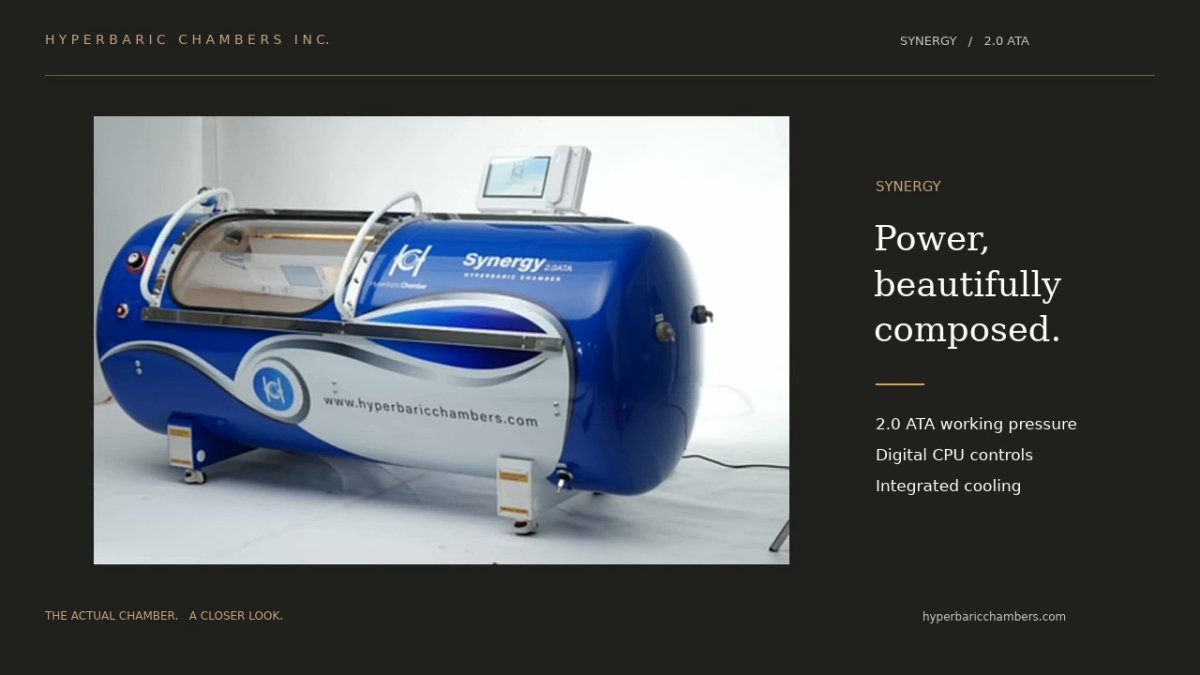
| Synergy 2.0 ATA | Lying | Hard-shell | 2.0 ATA | Hinged entry | Confirm on product page | Lying length | Larger | Confirm on product page |
Two patterns stand out. Seated models suit buyers who find transferring to a lying position difficult. Lying models suit buyers who want to rest flat for the full session. Pressure is a separate axis entirely: our range spans 1.3 ATA to 2.0 ATA, and posture does not restrict which pressure you choose.
Home Hyperbaric Chamber Dimensions: Cabin Size vs Installed Space
Home hyperbaric chamber dimensions are not the same as the space the chamber occupies in a room. Cabin size is the internal volume your body sits or lies inside. Installed space adds the clearance around the shell for entry, the compressor, tubing and safe access for a support person.
A common mistake is measuring only the shell footprint, then discovering the compressor has nowhere to sit. Plan for both.
For seated models, measure the doorway the chamber must pass through, plus the arc a seated user needs to stand and step in. For lying models, measure the full length of the shell plus entry clearance at the zip end. If you are comparing options, our model comparison page can help.
What Taller Users Should Check Before Choosing a Lying Chamber
Taller buyers should check usable interior length, not external shell length. A lying chamber that fits the room can still be too short inside for a comfortable full-length session.
Before you commit, confirm three things with our team: the internal length of the specific model, whether your height allows a relaxed lying position rather than a fixed one, and how much headroom remains once a pillow or support is added. Do not assume one lying model's interior matches another. Interior measurements vary across the range.
Send us your height before shortlisting. We can help you understand which lying models might offer full-length comfort and which might feel tight.
Hyperbaric Chamber Entry and Exit: What to Test Before You Buy
Hyperbaric chamber entry and exit is the single best predictor of whether you will use the chamber daily.
Test four things before buying:
- Can you enter and exit without twisting or straining?
- Does the zip or door sit at a height you can reach comfortably?
- Can a support person assist without blocking the opening?
- Is there room to sit and settle before the session begins?
For seated models, the entry motion is closer to sitting into a chair. For lying models, you lower yourself along the length of the shell. If you find lying flat or transferring difficult, a seated model removes that step entirely. If you use a wheelchair, our Eclipse Wheelchair 1.4 ATA is designed around access, and our team can talk you through how a session works in practice.
Choosing a Hyperbaric Chamber for Limited Mobility
A hyperbaric chamber for limited mobility should be selected on access first, pressure second. If you cannot get in and out safely and independently, no specification advantage matters.
Seated and wheelchair-accessible models exist for exactly this reason. The Eclipse 1.5 ATA Seated and Eclipse Elite 2.0 ATA Seated let you take a session upright, which suits buyers who cannot lie flat or who need a support person close by. The Eclipse Wheelchair 1.4 ATA is built around wheelchair access.
One distinction matters here. A chamber with internal controls can be operated from inside, but that is not the same as a session being appropriate without an attendant. Whether you need supervision depends on your circumstances and the model's verified documentation. Check the operating instructions for your exact model, and confirm supervision requirements with our team rather than assuming.
Realistic Buyer Scenarios: Matching Posture to Daily Life
Scenario one: a retired buyer with knee trouble who cannot lower to the floor without help. A seated model removes the transfer entirely.
Scenario two: an athlete recovering between training blocks who wants to lie flat and rest for the full session. A lying model with a larger shell fits a garage corner, provided the compressor has its own space.
Scenario three: a buyer who tried a clinic chamber and felt closed in. A seated soft-shell model with a partly open zip during setup, and a clear view through the shell, may feel less confined than a full-length tunnel. We cover this in more detail in our guide to claustrophobia and chamber choice.
Scenario four: a household where two people share one chamber. A lying model may suit one user and frustrate the other. Match the model to the person who will use it most, not the average of both.
Five Questions to Ask Before Choosing a Chamber
- Can I enter and exit this model comfortably, unaided or with the help I have?
- Does the usable interior fit my height and preferred position?
- Have I measured installed space, including compressor and entry clearance?
- Which pressure suits my goal, and is it independent of my posture choice?
- Does this model include the monitoring and controls I want, or do I need a higher tier?
Pressure, shell type and equipment differ across our range. Selected models include CPU controls, carbon dioxide monitoring and scrubbers, and dedicated oxygen delivery through a mask. The entry-level iRestore 1.3 ATA has HEPA filtration and a two-year warranty, without CPU controls or a carbon scrubber. Do not assume one model's features apply to another. Confirm the exact specification on the product page.
Conclusion
Position alone does not establish how effective a chamber will be. Posture, shell construction and operating pressure are separate decisions, and the right posture is the one you can enter, settle into and repeat comfortably.
Start with access and usable space, then choose pressure and equipment. If you are unsure which models fit, send our team your height, your room dimensions and whether you prefer seated or lying, and we will put together a shortlist for you to compare.
Frequently Asked Questions
What is the difference between a seated and lying hyperbaric chamber?
The main difference is posture and shell type. A lying chamber, such as the Eclipse Elite 1.35 ATA, Eclipse Elite Pro 1.5 ATA or Synergy 2.0 ATA, lets you recline or lie flat inside a longer shell. A seated chamber, such as the Eclipse 1.5 ATA Seated or Eclipse Elite 2.0 ATA Seated, has you upright in a shorter, taller shell. Posture, construction and operating pressure are separate choices, so a seated model is not automatically lower pressure than a lying one.
Are seated hyperbaric chambers more comfortable than lying ones?
Comfort depends on your body and session length, not the category alone. Seated models suit people who find lying flat uncomfortable, who need to keep their head elevated, or who want to read or use a device upright. Lying models suit people who prefer to stretch out or rest during a session. If you have joint pain, reflux or breathing difficulty when flat, a seated chamber is worth shortlisting. Try to confirm cushioning and legroom on the exact model before deciding.
How much room does a home hyperbaric chamber need?
Plan for the cabin footprint plus clearance for entry, exit and any support person. A lying chamber needs a longer floor area than a seated one, so measure your room against both the external dimensions and the usable interior space. Also allow space for the compressor and oxygen equipment, which usually sit outside the chamber. Send your room dimensions to our team and we can confirm which models fit before you commit.
Can a seated hyperbaric chamber suit someone with limited mobility?
Often, yes. A seated shell can reduce the need to lower yourself onto the floor of a lying chamber, and some models are designed for easier transfer from a chair. If you use a wheelchair or have difficulty with transfers, tell our team how you move in and out of a chair, and we can point you to the seated or wheelchair-accessible options in our range. Always confirm entry height, threshold and any assistance needed for the exact model.
